
Vorakai Konekta Challenge 2026 · AI & Data track
Grow smarter,
go further.
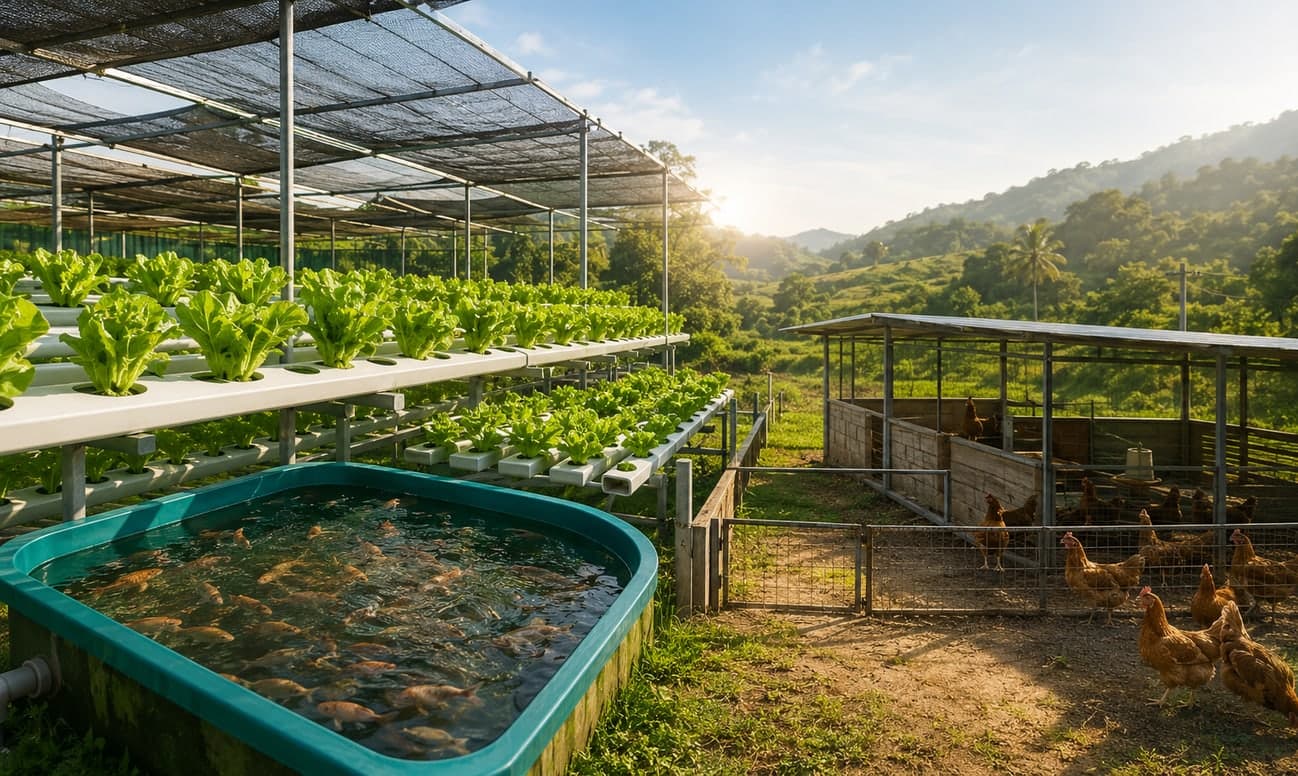
VIEM Konekta Farms are connected, solar-powered aquaponic and hydroponic units run by suco cooperatives. Fish feed the plants, waste feeds the fish — and the suco's new connection keeps the whole loop alive.
- Tetum-first alerts
- Solar & battery powered
- Offline-first sensing
- less water than soil farming
- 90%
- footprint for each Suku Unit
- 150 m²
- paid local jobs per unit
- 3–5
- months to pay back set-up
- 12–18
Visionary Innovation for Environmental Management
A modern agribusiness growing a regenerative Timor-Leste
VIEM combines smart farming technology, modern cultivation systems and regenerative practice. At the heart of it is circular agriculture — turning organic waste and by-products into feed, fertiliser and food.
01Grow
We build productive, efficient farming systems designed to deliver consistent, high-quality output all year — including the dry season.
02Innovate
We integrate sensors, data and a Tetum-first farm assistant so small teams can run many farms well, even on shared satellite links.
03Sustain
We apply regenerative, circular practices: organic waste becomes fish feed and compost, and every output feeds the next stage.
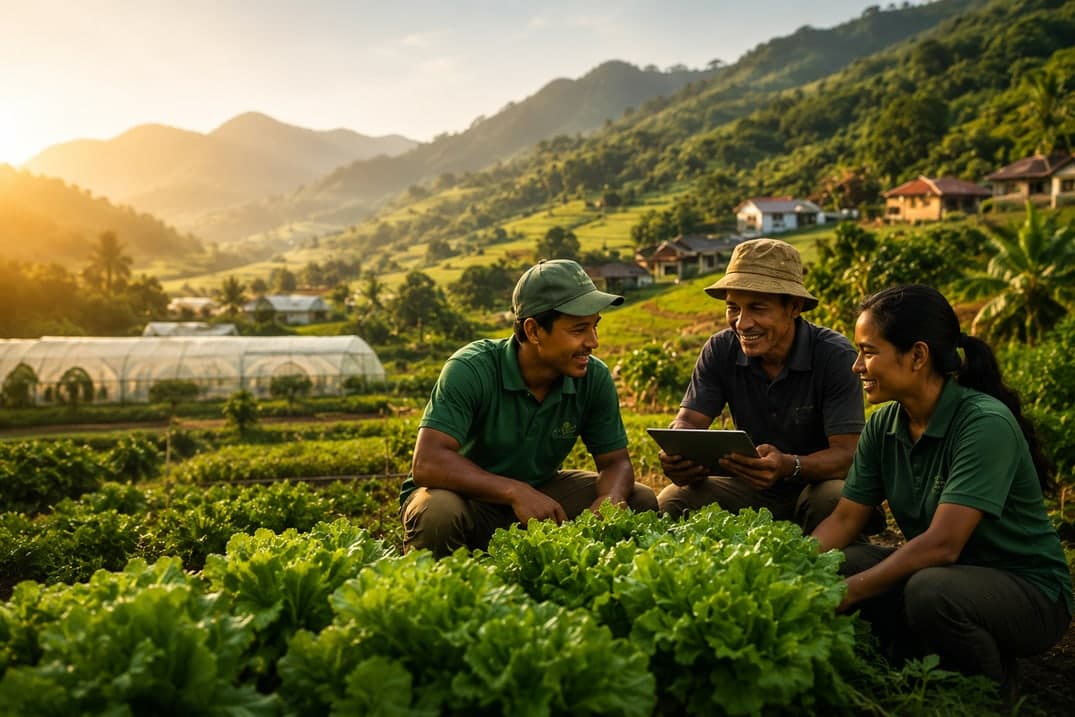

Year-round
harvests, even in the dry season

The problem
Four connected problems, one farm model
Hydroponics and aquaponics have been tried before — usually as donor demonstrations. Most failed because no one noticed when the water chemistry went wrong, feed was imported and expensive, and there was no guaranteed buyer.
Nutrition
Diets are rich in rice but poor in vegetables and affordable protein (Timor-Leste Food and Nutrition Survey, 2020).
≈ 1 in 2 children under five are stunted
Import dependence
Supermarkets and hotels in Dili rely heavily on vegetables and fish imported from Indonesia and Australia.
Seasonal local supply
Water & climate
Erratic rainfall and degraded soils limit what can be grown in the open field for much of the year.
Long dry season
Waste & work
Market and household organic waste is dumped or burned, while rural youth and women have few paid jobs close to home.
Few paid rural jobs
Newly connected sucos change the first reason. VIEM's circular design and guaranteed buy-back address the other two.
The solution
One circular loop on 150 m²
Every VIEM Suku Unit sits beside a suco office, school or community hall and combines three linked systems. Tap a stage to follow the loop.
The VIEM loop
Every output feeds the next
Stage 1 of 5
Market & kitchen waste
- 1ProcessBlack soldier fly larvae composting
- 2OutputProtein larvae and frass
- 3Goes toFish feed and compost
Feeds into: Fish
Fish and plants share one water
Aquaponics
A 2,000-litre tank holds tilapia. Their water flows through a biofilter where bacteria turn ammonia into nitrate, then through grow beds of leafy greens, herbs and fruiting crops. Clean water returns to the fish — no chemical fertiliser needed.
Fast, high-value greens
Hydroponics
NFT (nutrient film) channels under a shade-net house grow lettuce, pak choi, kangkung and basil in 4–6 weeks, fed partly by aquaponic water and partly by organic liquid fertiliser brewed from compost.
Waste becomes feed and fertiliser
Circular inputs
Organic waste feeds black soldier fly larvae — high-protein fish and poultry feed. Their frass and plant trimmings become compost. Rain is harvested from the roof and a small solar array with battery runs the pumps and sensors.


How connectivity makes it work
A pump that stops can kill fish within hours
Aquaponics is only forgiving when problems are caught early. The suco's new connection lets a small VIEM team support many remote units — without driving to each one.
- Offline-first
- Solar + battery
- Tetum-first
- Local safety rules
- 01
Sensor kit
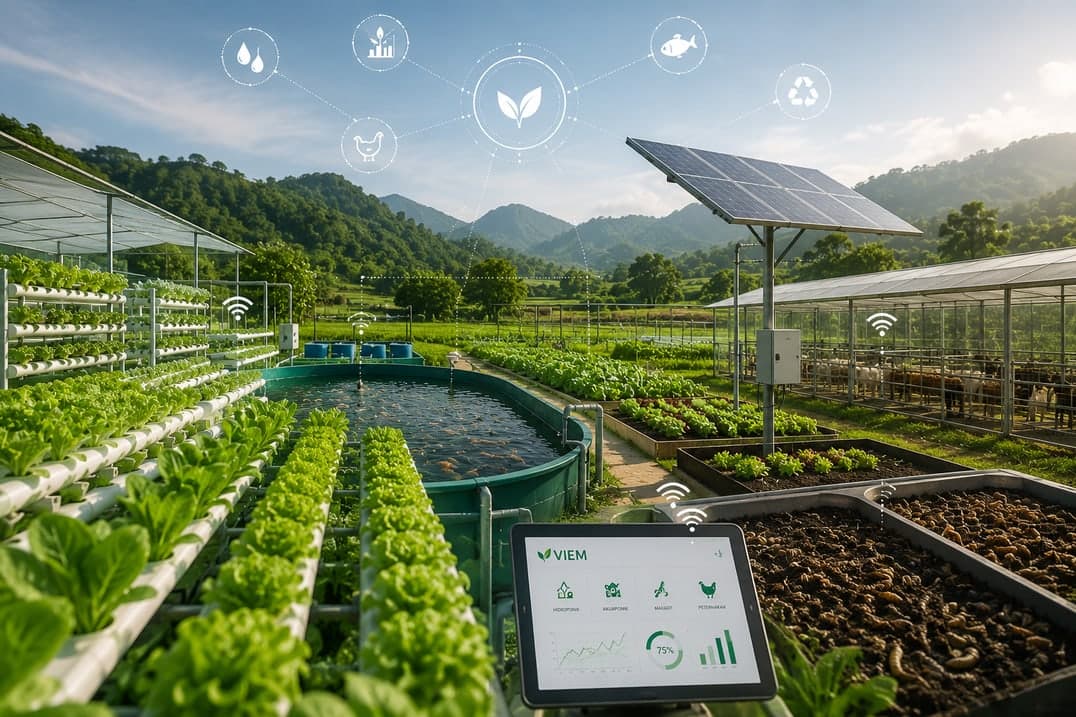
An ESP32 controller on every tank measures water temperature, pH, dissolved oxygen, EC/TDS, tank level, air climate and pump current.
- 02
LoRa radio
Readings hop by long-range, low-power radio to a small gateway at the suco office — no Wi-Fi needed at the farm.
- 03
Vorakai link
The gateway shares the suco's satellite connection and uploads compressed batches — just a few kilobytes an hour.
- 04
Hub & Tulun VIEM
The VIEM Hub dashboard watches every unit, while Tulun VIEM sends plain-Tetum alerts and advice on WhatsApp or SMS.
Tulun VIEM
Asistente agrikultura · online
Alerta · Suku Unit 01
Oksijéniu tun (4.6 mg/L). Haree pompa ar agora.
Oxygen is low. Check the air pump now.
06:42
Tanba sa mak alfase sira-nia tahan kinur?
Why are the lettuce leaves turning yellow?
06:51
Tahan kinur bele tanba nutriente ki'ik ka pH aas liu. Sukat EC no pH, depois haree lista foto.
Yellow leaves can mean low nutrients or high pH. Measure EC and pH, then follow the photo checklist.
VIEM Manual §4.2 · Nutrients
Tulun VIEM · the Tetum farm assistant
Plain-Tetum alerts and advice, on the phone operators already use
Operators receive alerts on WhatsApp, with SMS as a fallback. Alerts are rule-based and always fire, AI or not. For questions, Tulun VIEM answers only from VIEM's vetted growing manual and hands over to a named agronomist when confidence is low.
- Rule-based alarms fire even when the AI or the link is down
- Degrades step by step: SMS menu → laminated guide → call the Hub
- Never recommends chemicals, changes prices or closes alerts on its own
The VIEM dashboard
Try the Hub dashboard — live, in your browser
Watch simulated sensors report every 30 seconds, switch pumps and aeration by hand or let automation run them, set alarm limits, acknowledge Tetum alerts and log harvests for buy-back.
- 7 live sensors per unit
- Manual, auto & scheduled control
- Hysteresis rules + safety interlocks
- Tetum-first alerts with acknowledgement
- Offline-first link simulation
- Harvest, buy-back & forecast


Social impact
Every unit is a business, not a donation
Cooperatives own and run their units. VIEM supplies, supports and buys back the harvest at an agreed floor price.
Jobs close to home
Each Suku Unit employs 3–5 cooperative members, prioritising women and young people. Operators earn a share of sales, not a stipend.
School nutrition
Units at schools supply fresh greens and fish to school meals (Merenda Eskolar) and double as a living classroom.
Skills that transfer
The VIEM Academy trains operators in fish care, water chemistry, basic electronics, record-keeping and digital tools.
Cleaner sucos
Each unit diverts an estimated 50–100 kg of organic waste a week from burning or dumping.
Climate resilience
Year-round production that does not depend on rainfall or soil fertility — using a fraction of the water.
Rollout plan
From a 3-month pilot to 30+ units
VIEM breaks even at Hub level at roughly 20 Suku Units — aggregated, predictable volumes win supply contracts that small farmers cannot win alone.
- Pilot3 months
VIEM Hub demo system plus 2 Suku Units at Vorakai-connected sites — one school, one suco office — with sensors and Tulun VIEM live.
Success measureFish survival > 90% · alerts answered < 2 hours · first buyer contract
- Year 110 units
10 Suku Units in 3 municipalities, a black soldier fly feed plant at the Hub, and school supply agreements.
Success measure50 operators trained · 40% of feed from BSF
- Years 2–330+ units
30+ units, a second hub outside Dili, and kit sales to partners.
Success measureHub break-even · operators earning above minimum wage
The team
Rooted in Timor-Leste, built to scale

Director
Deviana Sarmento
Finance and operations; business model, cooperative finance and buyer contracts.

General Manager
Escolastico Sarmento
Marketing and distribution; offtake with supermarkets, hotels and schools.

Commissioner
Yuma Rafi
Operational systems across Indonesia and Timor-Leste; Hub set-up and scaling.
- LF
Developer & IoT Implementation
Luis Ferdinand
Sensor kits, LoRa gateway, the Tulun VIEM assistant and the VIEM dashboard; on-site installation and technical support.

Vorakai Konekta Challenge 2026
Read the full proposal — every assumption, risk and number.
Eleven pages covering the circular design, offline-first sensing, Tulun VIEM, unit economics, rollout, failure modes and how we adapt when constraints change.
Preview it online and see how it answers the judging criteriaVIEM Konekta Farms: connected circular hydroponic & aquaponic hubs
Fish feed the plants, waste feeds the fish, and the suco's new connection keeps the loop alive.

Host a unit, buy our harvest or partner with VIEM
Schools, suco offices, buyers, NGOs and government partners — we would love to talk.